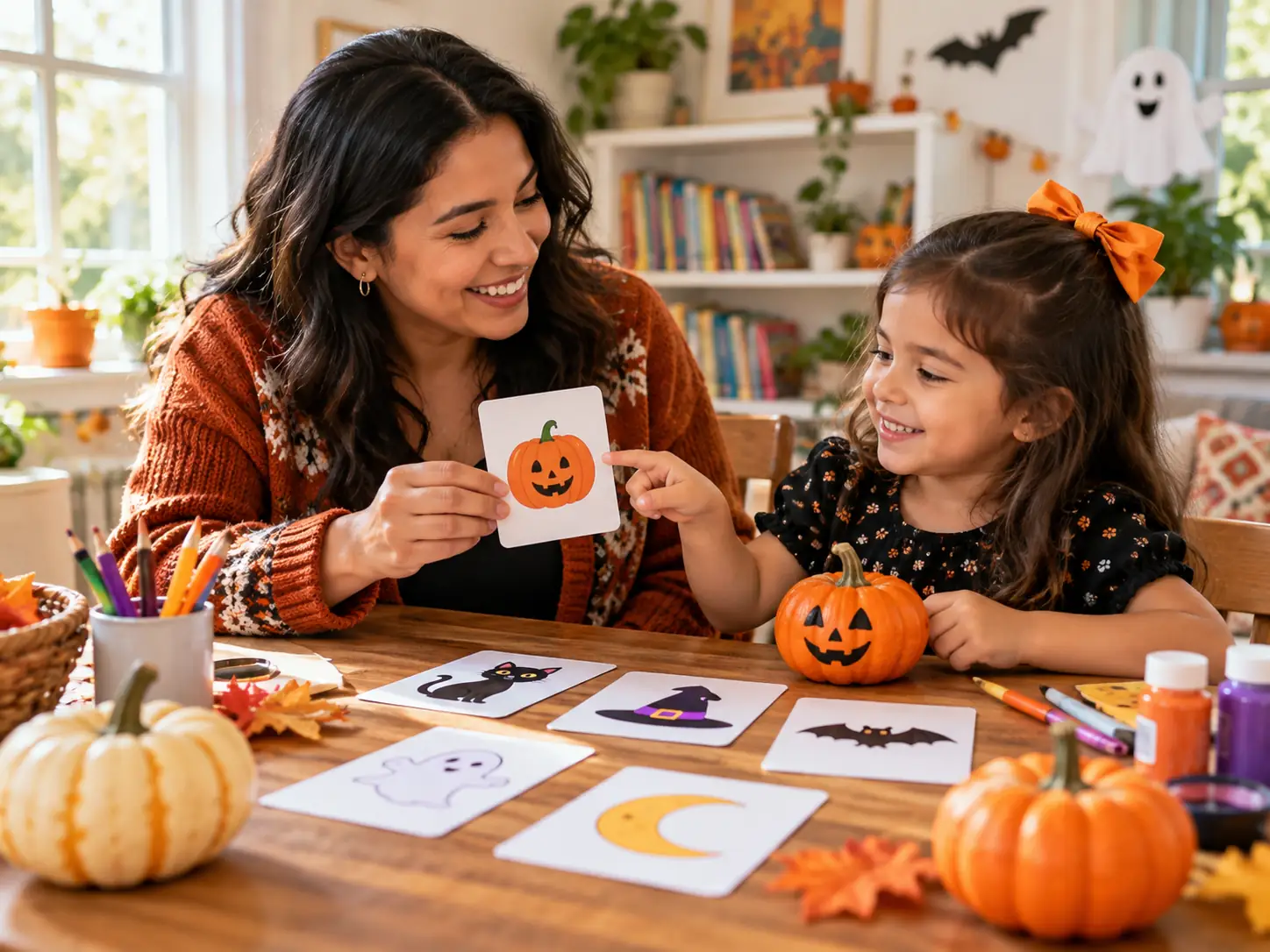
Halloween can be an exciting opportunity to practice a little Spanish without making it feel like homework. A few picture cards, a handful of familiar objects, and five minutes together can turn the excitement into a language game.
I'm Anlly from Hola Let's Go, and I love the idea of connecting new words to the little moments families already share. You don't need a perfect accent or an elaborate lesson. Start with a smile, repeat together, and have fun.
10 Halloween Words to Learn in Spanish
Begin with just three or four words if your child is new to Spanish. Add more only if they are excited to continue.
- La calabaza (lah kah-lah-BAH-sah) — the pumpkin
- El fantasma (ehl fahn-TAHS-mah) — the ghost
- La bruja (lah BROO-hah) — the witch
- El murciélago (ehl moor-SYEH-lah-goh) — the bat
- El gato negro (ehl GAH-toh NEH-groh) — the black cat
- El disfraz (ehl dees-FRAHS) — the costume
- Los dulces (lohs DOOL-sehs) — the candies or sweets
- La casa (lah KAH-sah) — the house
- La noche (lah NOH-cheh) — the night
- ¡Qué miedo! (keh MYEH-doh) — How scary!
A quick pronunciation tip: Spanish vowels are generally pronounced more consistently than English vowels. Listening and repeating together is a great way to build comfort, even before everything sounds perfect.
Play a Five-Minute Halloween Picture Hunt
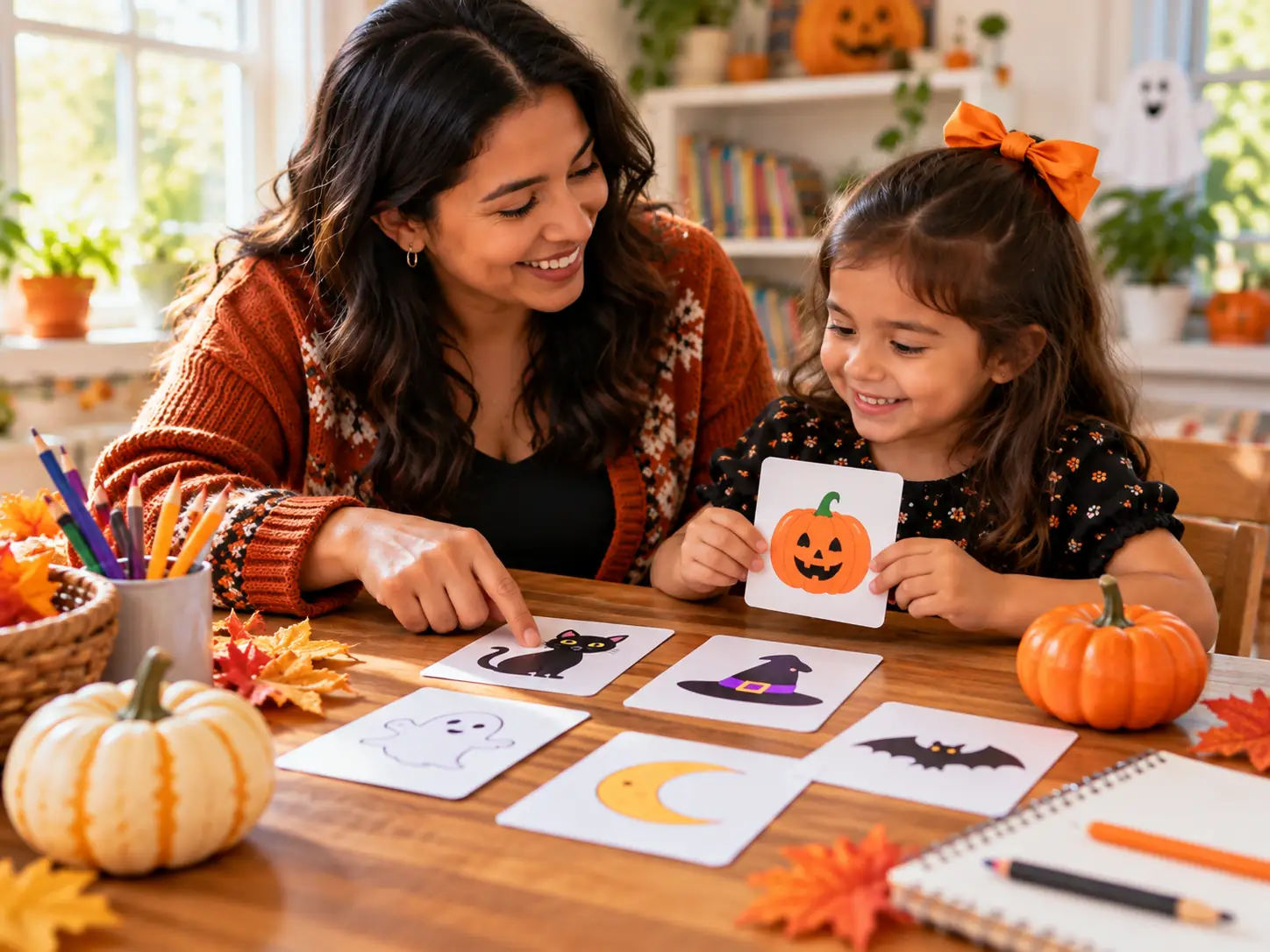
Gather a few Halloween decorations or draw simple pictures. A pumpkin, a ghost, a bat, and a cat are plenty.
Ask your child to point to an object when you name it in Spanish. Then trade roles so your child gets to be the teacher.
Try these little sentences:
- Veo una calabaza. (VEH-oh OO-nah kah-lah-BAH-sah) — I see a pumpkin.
- Veo un fantasma. (VEH-oh oon fahn-TAHS-mah) — I see a ghost.
- ¿Dónde está la bruja? (DOHN-deh ehs-TAH lah BROO-hah) — Where is the witch?
- ¡Aquí está! (ah-KEE ehs-TAH) — Here it is!
If your child answers by pointing instead of speaking, that's fine. Understanding is an important part of learning to communicate.
Practice a Short Conversation Before Going Out
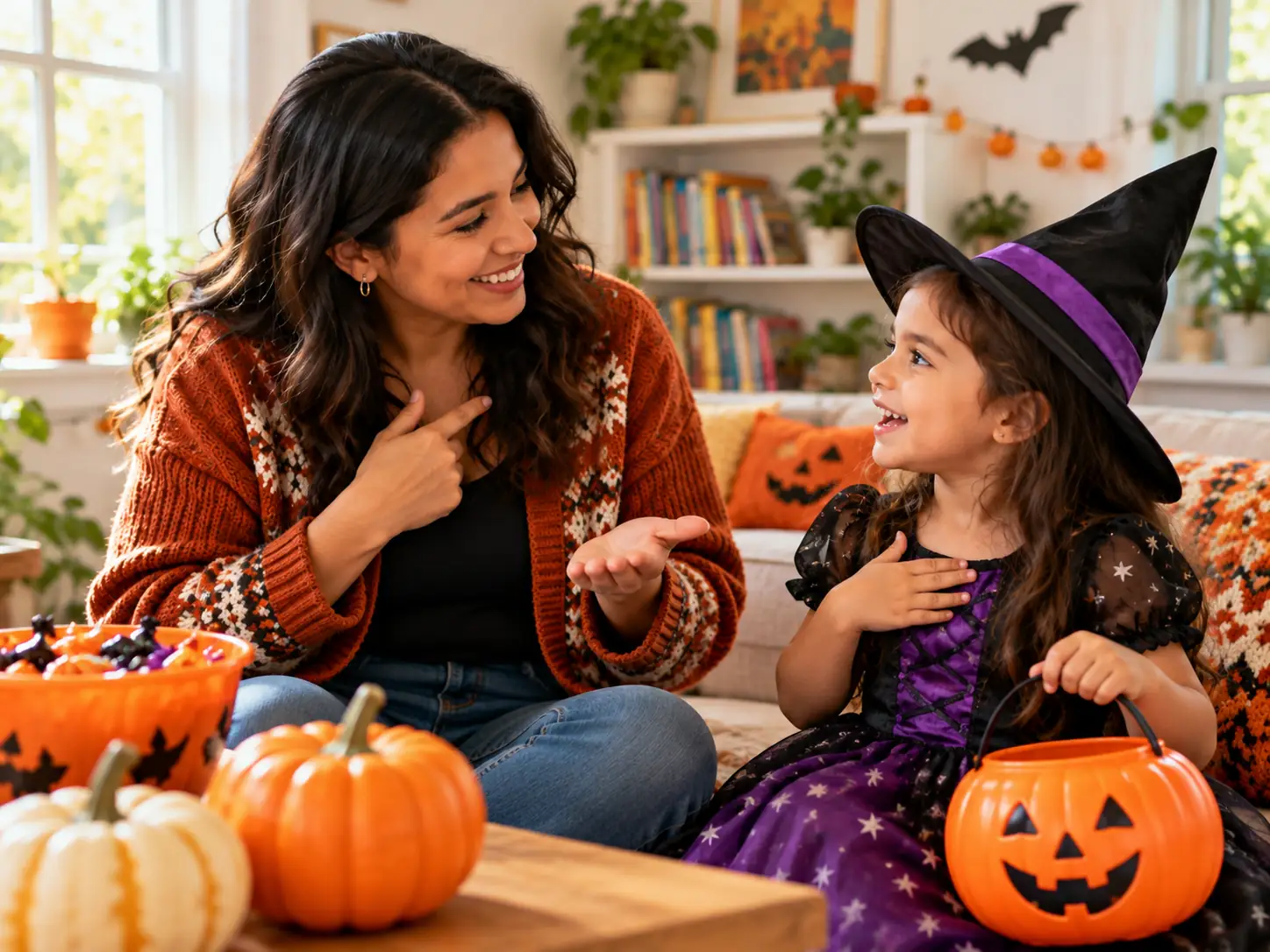
You can use Halloween excitement to practice real conversation, not just vocabulary lists.
Adult: ¿Qué ves? (keh vehs) — What do you see?
Child: Veo una calabaza. (VEH-oh OO-nah kah-lah-BAH-sah) — I see a pumpkin.
Adult: ¿Te gusta tu disfraz? (teh GOOS-tah too dees-FRAHS) — Do you like your costume?
Child: ¡Sí, me gusta! (see meh GOOS-tah) — Yes, I like it!
Before leaving, practice two especially useful expressions:
- Por favor (pohr fah-VOHR) — Please
- Gracias (GRAH-syahs) — Thank you
Families celebrate Halloween differently, and the phrase used for “trick or treat” can also vary across Spanish-speaking regions. For a beginner, a friendly ¡Gracias! is a wonderful place to start.
Keep It Playful, Not Perfect
If your family only practices one word tonight, that counts. Repeat it while decorating a pumpkin, choosing a costume, or spotting decorations on a walk.
Here is a simple challenge: let everyone pick one Spanish Halloween word and use it three times. Children often enjoy hearing grown-ups try a new language, too.
The goal isn't to memorize everything before bedtime. It's to help Spanish feel like a natural, happy part of everyday family life.
Want help making Spanish part of your family's routine? At Hola Let's Go, we offer personalized online Spanish lessons and in-person tutoring in the Huntsville–Madison area. You can book a free 15-minute consultation to talk about your family's goals.